Calculating the cash flow statement (TFT)
This guide shows you how to generate the TFT (Tableau des Flux de Trésorerie — Statement of Cash Flows) of SYSCOHADA revised 2019 and how to read its three sections to understand how your company generated and used its cash. While the income statement measures accounting performance, the TFT measures cash performance — two concepts that are often very different for an SME.
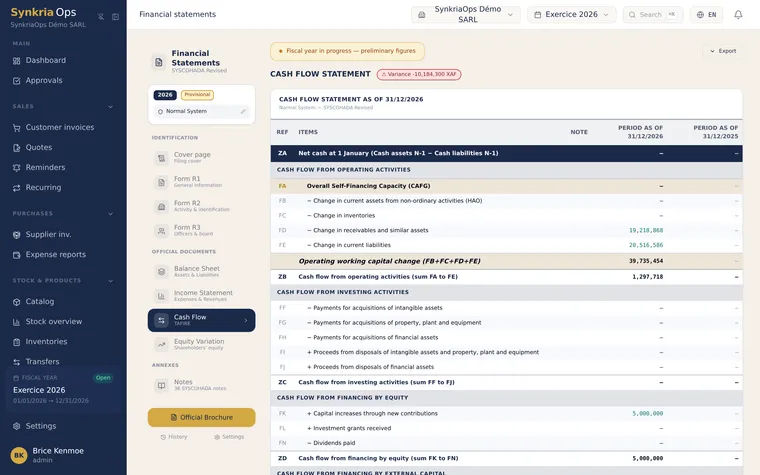
Accessing the TFT
Section titled “Accessing the TFT”From the navigation bar: Financial Statements → TFT.
Select the fiscal year. The TFT is calculated over the full fiscal year (unlike the balance sheet, which can be generated at an intermediate date T).
Checking the prerequisites before generating
Section titled “Checking the prerequisites before generating”-
Balanced fiscal year — The trial balance must show ΣD = ΣC. Check in the trial balance.
-
Fixed assets recorded — Acquisitions and disposals during the year must be posted in class 2 with the corresponding depreciation (account 28xxx).
-
Class 16 accounts up to date — New borrowings (debit 521, credit 162) and repayments (debit 162, credit 521) must be posted.
-
Correct N-1 opening balances — The TFT compares balances N and N-1. Opening balances must be accurate.
Reading the three sections of the TFT
Section titled “Reading the three sections of the TFT”Section 1 — Operating flows
Section titled “Section 1 — Operating flows”Operating flows measure the cash generated (or consumed) by the company’s normal business activity.
Starting point: Self-Financing Capacity (SFC / CAF)
SFC = Net result + Depreciation and provisions − Provisions written back
Depreciation is an accounting expense with no actual cash outflow — it is therefore added back to the net result to obtain the potential cash flow.
Change in Working Capital Requirement (ΔWCR)
| Change | Effect on cash |
|---|---|
| Increase in inventories | Consumes cash |
| Increase in trade receivables | Consumes cash (customers paying later) |
| Increase in trade payables | Generates cash (paying suppliers later) |
Operating cash flow = SFC ± ΔWCR
Section 2 — Investing flows
Section titled “Section 2 — Investing flows”Investing flows trace capital decisions: acquisition or disposal of long-lived assets.
| Transaction | Effect |
|---|---|
| Equipment purchase (debit 241) | Use = cash outflow |
| Vehicle purchase (debit 244) | Use = cash outflow |
| Asset disposal (credit 24xxx) | Resource = cash inflow |
Investing cash flow = Disposals − Acquisitions
A negative investing cash flow (outflows > inflows) is generally a positive signal: the company is investing in its growth. A zero or positive investing flow (disposals > acquisitions) means the company is divesting — worth monitoring.
Section 3 — Financing flows
Section titled “Section 3 — Financing flows”Financing flows trace relationships with capital providers (shareholders and banks).
| Transaction | Effect |
|---|---|
| Capital increase | Resource = cash inflow |
| New bank loan | Resource = cash inflow |
| Loan repayment | Use = cash outflow |
| Dividend payment | Use = cash outflow |
Financing cash flow = (Capital + New loans) − (Repayments + Dividends)
Verifying the net change in cash
Section titled “Verifying the net change in cash”Net change in cash = Operating flows + Investing flows + Financing flows
This figure must correspond exactly to the difference between the closing cash balance at 31/12/N and 31/12/N-1 (sum of class 5 accounts: bank accounts + petty cash + current accounts).
Reading a full example
Section titled “Reading a full example”TFT of a Cameroonian SME for fiscal year 2025:
| Line | Amount (XAF) |
|---|---|
| SECTION 1 — OPERATING | |
| Net result | 7,500,000 |
| + Depreciation (681) | 2,800,000 |
| = Self-financing capacity (SFC) | 10,300,000 |
| − Increase in inventories | −1,700,000 |
| − Increase in trade receivables | −2,700,000 |
| + Increase in trade payables | +2,550,000 |
| = Operating cash flow | 8,450,000 |
| SECTION 2 — INVESTING | |
| Computer equipment acquisition | −1,800,000 |
| Delivery vehicle acquisition | −4,500,000 |
| Disposal of old equipment | +800,000 |
| = Investing cash flow | −5,500,000 |
| SECTION 3 — FINANCING | |
| Bank loan repayment | −3,200,000 |
| Dividends paid | −1,200,000 |
| = Financing cash flow | −4,400,000 |
| = NET CHANGE IN CASH | −1,450,000 |
| Opening cash (N-1) | 14,600,000 |
| Closing cash N (verification) | 13,150,000 |
Interpretation: despite a profit of 7,500,000 XAF, cash decreased by 1,450,000 XAF. The company invested 6,300,000 XAF in fixed assets and returned 4,400,000 XAF to capital providers. Operations are generating solid cash (8,450,000 XAF) but investment and financing decisions have temporarily absorbed more than that flow.
Fixing common errors
Section titled “Fixing common errors”| Error | Likely cause | Solution |
|---|---|---|
| Net change in cash ≠ Δ balance sheet cash | Fixed asset purchase booked as an expense by mistake | Reclassify to a class 2 account via a corrective journal entry |
| Negative SFC | Net loss or depreciation not posted | Check depreciation entries for the year |
| Zero financing flow | Loans/repayments booked as journal entries without using account 162 | Check class 16 entries in the general ledger |
| Empty TFT | No N-1 fiscal year available | Normal for the first year — the TFT requires two balance sheets |
See also
Section titled “See also”- Calculating the SYSCOHADA balance sheet — The TFT connects the N and N-1 balance sheets by explaining the change in cash.
- Calculating the income statement — Net result is the starting point for the SFC calculation.
- Statement of changes in equity (TVCP) — The other statement of changes required by SYSCOHADA revised 2019.
- Liasse and SYSCOHADA notes (1 to 47) — The notes that mandatorily accompany the financial statements.